ACI infrastructure as code
Closing the manual networking gap in full-stack service provisioning.
- My role
- Architect & automation builder
- Context
- Service provider · Multi-tenant orchestration
- Project status
- Designed & built
Delivered capability
- End to endservice provisioning
- By codetenant isolation
Networking joined the self-service provisioning flow. No numerical provisioning-time reduction is claimed.
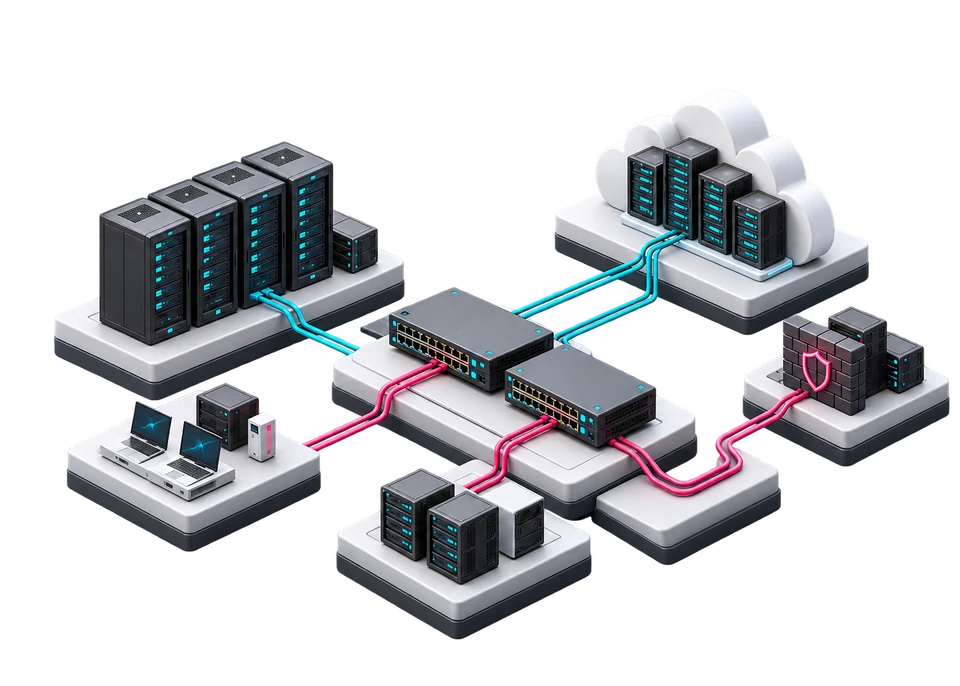
Inside the work
How I approached it
Model
Build a parameterized Terraform logical model for Cisco ACI.
Orchestrate
Let the existing platform request network constructs on demand.
Separate paths
Create an application profile for existing tenants, or the full tenant and VRF hierarchy for new clients.
Validate
Test the network and firewall automation before it reaches a production fabric.
Decisions & trade-offs
Architectural reasoning based on the supplied project account.
Model both tenant journeysExisting tenant or new client
Existing tenant or new client
The orchestration flow distinguished extending an existing tenant from building a complete isolated hierarchy.
The trade-off
The model must make ownership and scope explicit so a change remains inside the intended tenant.
Provision policy with the networkFirewall objects and access rules
Firewall objects and access rules
Security objects were automated alongside network constructs rather than added afterward.
The trade-off
Validation has to cover cross-domain dependencies, not only successful resource creation.
Prove repeatabilityValidation throughout the lifecycle
Validation throughout the lifecycle
The hard part was proving that the code behaved correctly and repeatably before touching production.
The trade-off
A successful first run is not enough evidence for safe ongoing orchestration.
Technologies by purpose
Automation & fabric
 Terraform
 Cisco
 Python
- IBM Cloud Orchestrator
Provisioning boundaries
- ACI
- Tenant / VRF
- Firewall objects
- Access rules
Scope & evidence
About this case
Project description supplied from LinkedIn. Private modules and client configurations are not published.
Carlos on LinkedInProject account
Multi-tenant self-service provisioning across compute, storage and networking. Networking no longer depended on a manual configuration step; no numerical provisioning-time claim is added.
Owner-reported account. Private client configurations and original architecture documents are not published with this case.