Network Design Compiler
Generate a consistent IP plan, port schedule, inventory and editable topology from one validated network model.
- My role
- Design & implementation
- Scope
- Offline network design compiler
- Release
- v0.1.0
Validation scope
Offline design consistency
107 tests and seven CLI scenarios. CI on Python 3.11–3.13. Reference: two sites, four devices, ten interfaces and three declared links. Synthetic data.
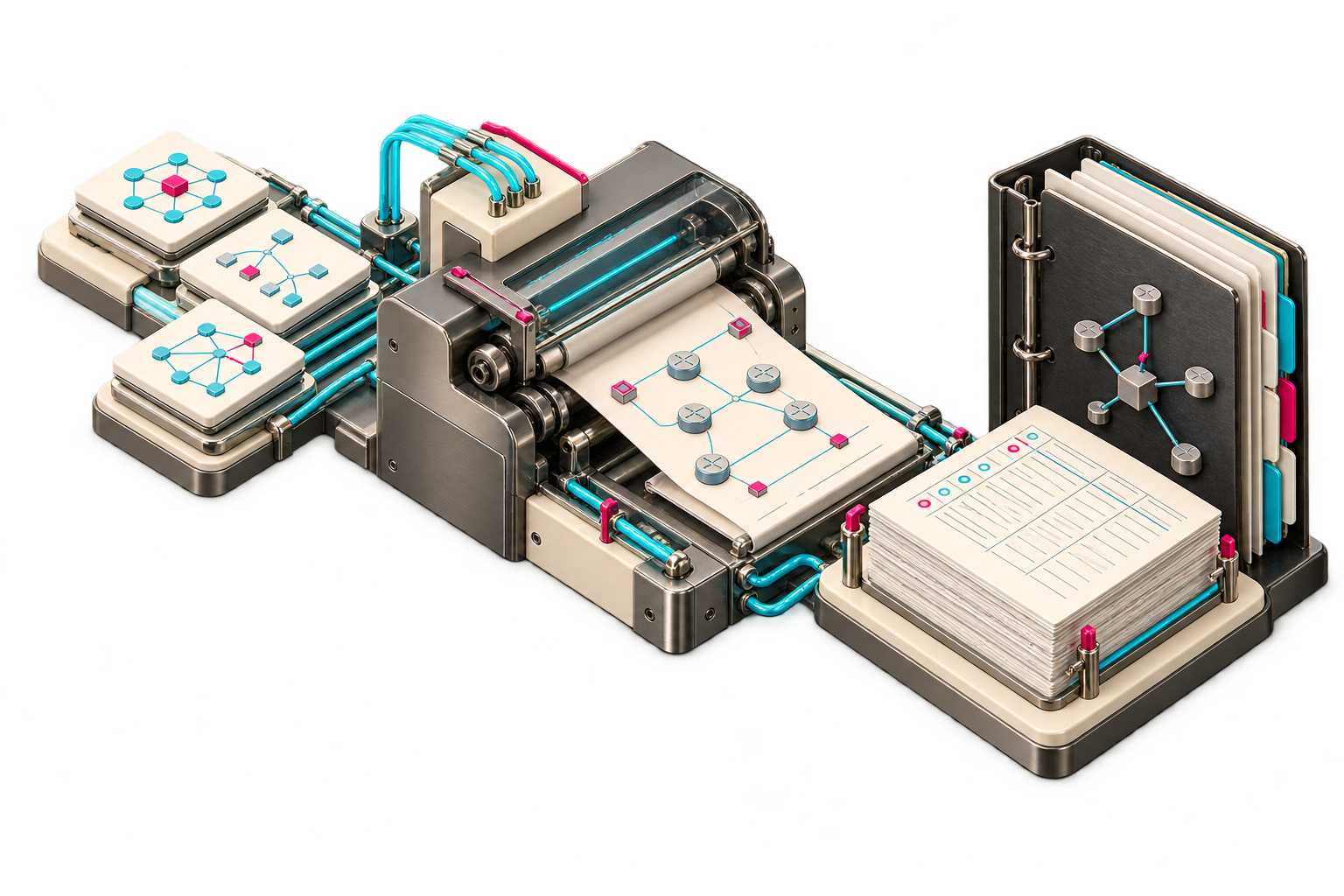
Inside the work
How it works
Declare the design
Define sites, VRFs, devices, interfaces and IPv4 segments in JSON. Specify port-to-port links and declared speeds explicitly.
Validate the model
Check references, duplicate addresses, overlaps, port reuse and endpoint consistency. Disconnected graphs remain visible as warnings.
Generate aligned documents
Produce eight artifacts: inventory, IP plan, port schedule, editable draw.io topology, engineering report, model, validation and manifest.
Review and reproduce
Follow link IDs across the diagram and tables. Rebuild into a fresh directory; verify artifact hashes. Invalid models emit only three reports.
Decisions & trade-offs
One model, multiple deliverablesDerive every document from the same input
Derive every document from the same input
Stable ordering and shared link identifiers keep the inventory, IP plan, port schedule and diagram consistent across rebuilds.
The trade-off
Edits made in draw.io do not flow back into JSON and are lost on regeneration. Keep presentation changes in a separate copy.
Reject misleading outputErrors produce reports, not a topology
Errors produce reports, not a topology
A duplicate IP, reused port or broken reference stops operational artifact generation. The failure still returns validation, a report and a manifest.
The trade-off
Graph disconnection is only a warning. A connected graph does not establish routing behavior or live reachability.
Keep the model boundedIPv4 routed links and loopbacks
IPv4 routed links and loopbacks
Version 0.1 covers /30 and /31 point-to-point segments, /32 loopbacks and VRF-scoped address checks with explicit endpoints.
The trade-off
L2 switching, VLAN trunks, IPv6, routing protocols and hardware compatibility require separate engineering review.
Technologies by purpose
Python
Offline CLI with no runtime dependencies after installation.
JSON model
Explicit sites, VRFs, IPv4 segments, interfaces and links.
draw.io XML
Native editable site containers, device shapes and link IDs.
CSV & Markdown
Inventory, IP assignments, port schedule and engineering report.
SHA-256 & CI
Artifact hashes and seven scenarios across Python 3.11–3.13.
Scope & evidence
Published evidence
- Release & example package
Eight-file example ZIP and checksum; no installation.
- Verification record
107 tests, seven CLI scenarios and declared scope.
- CI test matrix
Successful Python 3.11, 3.12 and 3.13 jobs.
- Input contract
Sites, VRFs, addressing and link cardinality.
- Engineering decisions
Deterministic output and file lifecycle.
Validation limits
- Offline consistency of declared intent. No discovery, vendor configuration generation, deployment, routing simulation or verified connectivity.
- IPv4 /30–/31 routed links and /32 loopbacks only. Device roles and speeds are declarations, not compatibility or performance evidence.
- Dense diagrams need visual review. Manual diagram edits are not imported back; file hashes and release checksums are unsigned.
Test captures
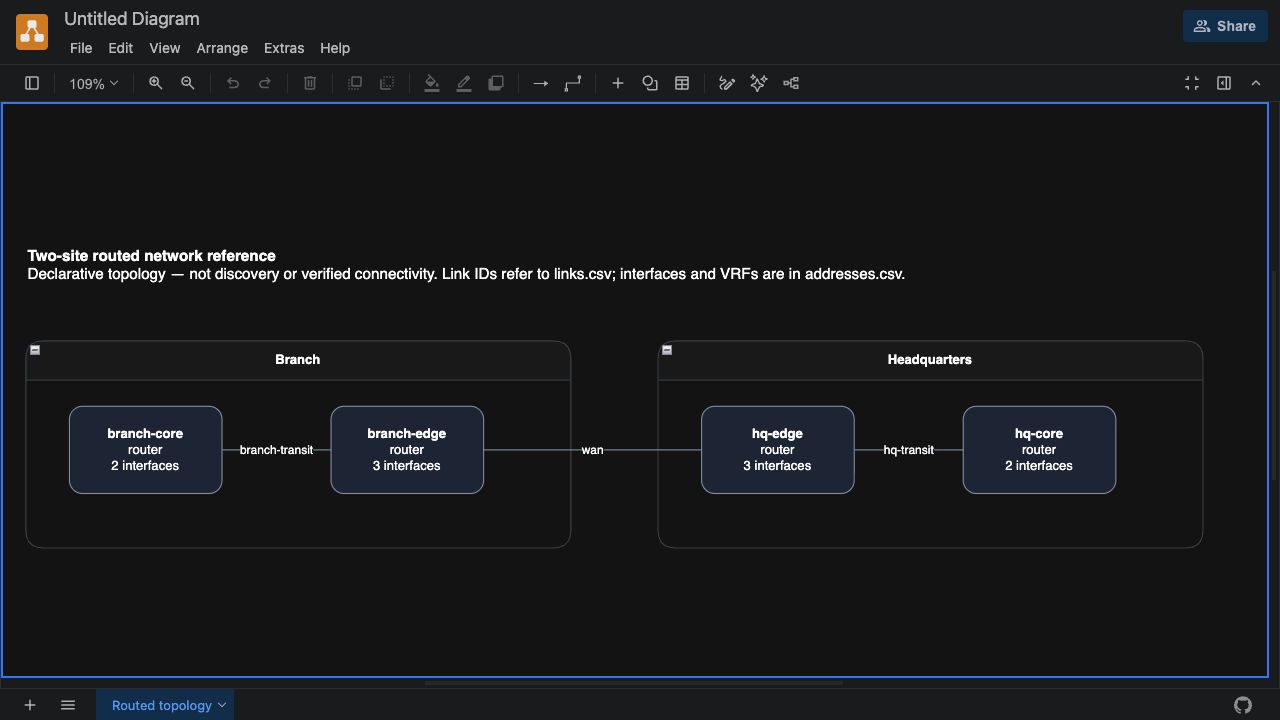
Recorded outputs · native draw.io topology and static evidence report.
 Enlarge
One model, an editable topology
Editable draw.io output: two sites, four devices, three links. Design intent, not tested connectivity.
Source · 2026-10-29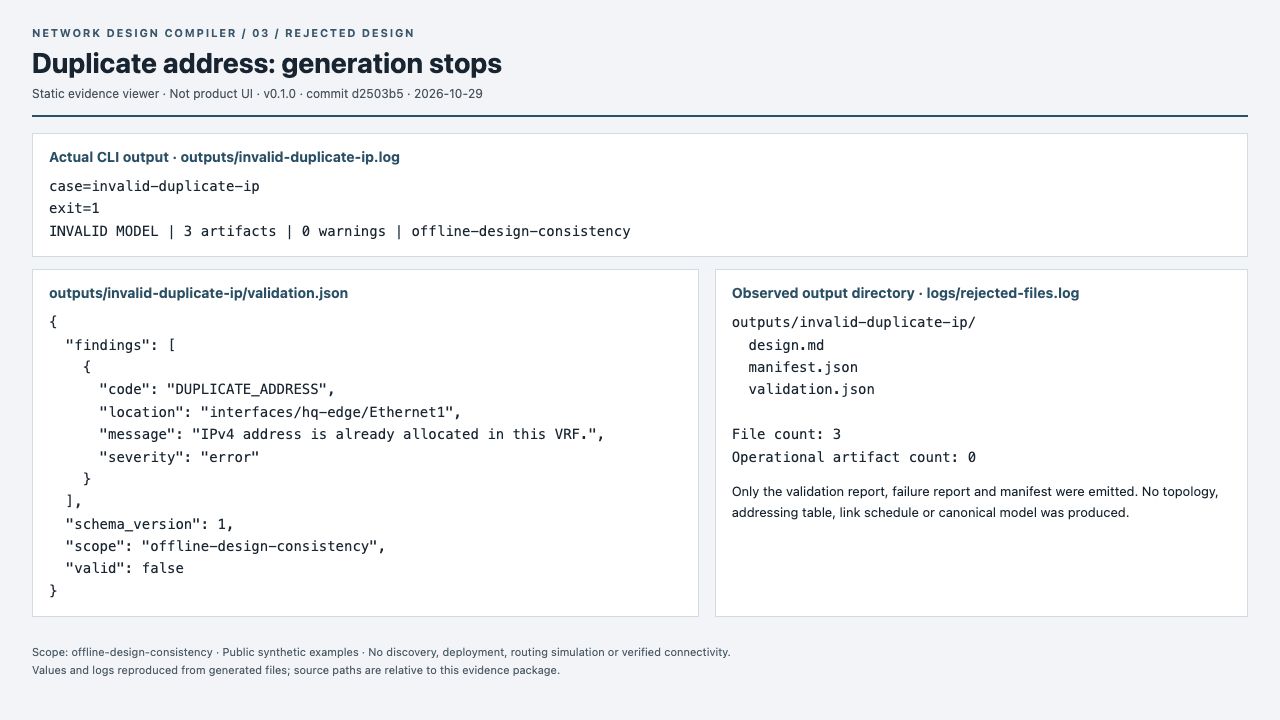 Enlarge
Duplicate address stops generation
Duplicate IP: exit 1 and three diagnostic files. No topology or IP tables. Static evidence viewer.
Source · 2026-10-29