ACI Policy Blueprint
Compile application communication requirements into a reviewable Cisco ACI policy design, a communication matrix and traceable engineering reports.
- My role
- Design & implementation
- Scope
- Offline ACI policy design compiler
- Release
- v0.1.0
Validation scope
Offline model validated
94 tests across Python 3.11–3.13 and seven CLI scenarios. Three-tier example: three EPGs, two contracts and four matrix rows. No APIC or fabric test.

Inside the work
How it works
Describe communication intent
Define a user tenant, VRFs, bridge domains, EPGs and TCP/UDP IPv4 flows in explicit JSON requirements.
Reject inconsistent models
Validate references, gateway/subnet semantics and service bounds. Reject cross-VRF flows, overlapping subnets and ambiguous intent.
Compile one review package
Generate the APIC object tree, bidirectional CSV matrix, findings and engineering review from the same canonical model.
Retain reproducible evidence
Record input and artifact hashes. Write into a new directory and publish the manifest last to mark a complete run.
Decisions & trade-offs
One contract per flowOne consumer and one provider
One consumer and one provider
Each contract represents one declared application relationship, avoiding additional consumer/provider combinations. Reverse-port rows are explicit.
The trade-off
More policy objects than shared contracts. Filters remain stateless, not connection-tracking firewall rules.
Stop at a reviewable designOffline compilation only
Offline compilation only
Generate policy intent without credentials, APIC transport or changes to an existing tenant. Engineering review remains a separate step.
The trade-off
Payload acceptance, bindings and effective access require APIC and fabric validation beyond this release.
Preserve each runFresh directory with a final manifest
Fresh directory with a final manifest
Refuse to overwrite previous output. A manifest records input and artifact hashes and identifies whether the model was valid.
The trade-off
Hashes detect changed bytes relative to the manifest; they are not a signature or proof of deployment correctness.
Technologies by purpose

Python
Dependency-free offline compiler and command-line interface.

Cisco ACI
Logical tenant, VRF, BD, EPG, contract and filter model.
JSON requirements
Explicit intent, schema bounds and canonical input.
CSV & Markdown
Bidirectional matrix and human-readable engineering review.
SHA-256 & CI
Artifact traceability and repeatable tests on three Python versions.
Scope & evidence
Published evidence
- Release v0.1.0
Published code, documentation and examples.
- Validation record
94 tests, seven cases and exact offline boundary.
- CI test matrix
Successful Python 3.11, 3.12 and 3.13 jobs.
- Design decisions
Policy semantics, restrictions and Cisco references.
- Reproducible examples
Synthetic valid and rejected design inputs.
Validation limits
- No APIC acceptance, deployment, fabric reachability or effective isolation was tested.
- Stateless TCP/UDP IPv4 filters; intra-EPG traffic remains unenforced. An absent matrix row does not prove denial.
- No L3Out, route leaking, bindings, IPv6, reconciliation or rollback. Existing fabric policies can alter effective access.
Test captures
Recorded evidence rendered as documents · not a product interface.
 Enlarge
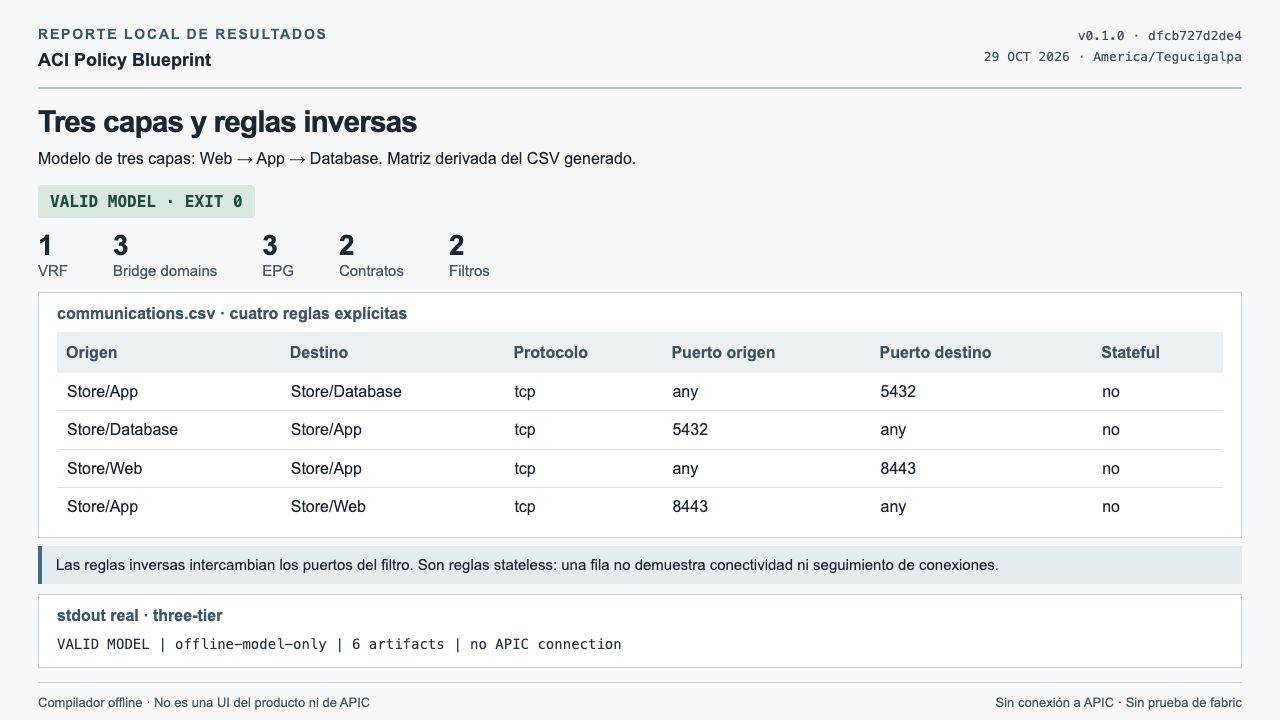
Three-tier communication matrix
Explicit forward and reverse-port rules generated from synthetic requirements. Offline model validation; not observed connectivity.
Source · 2026-10-29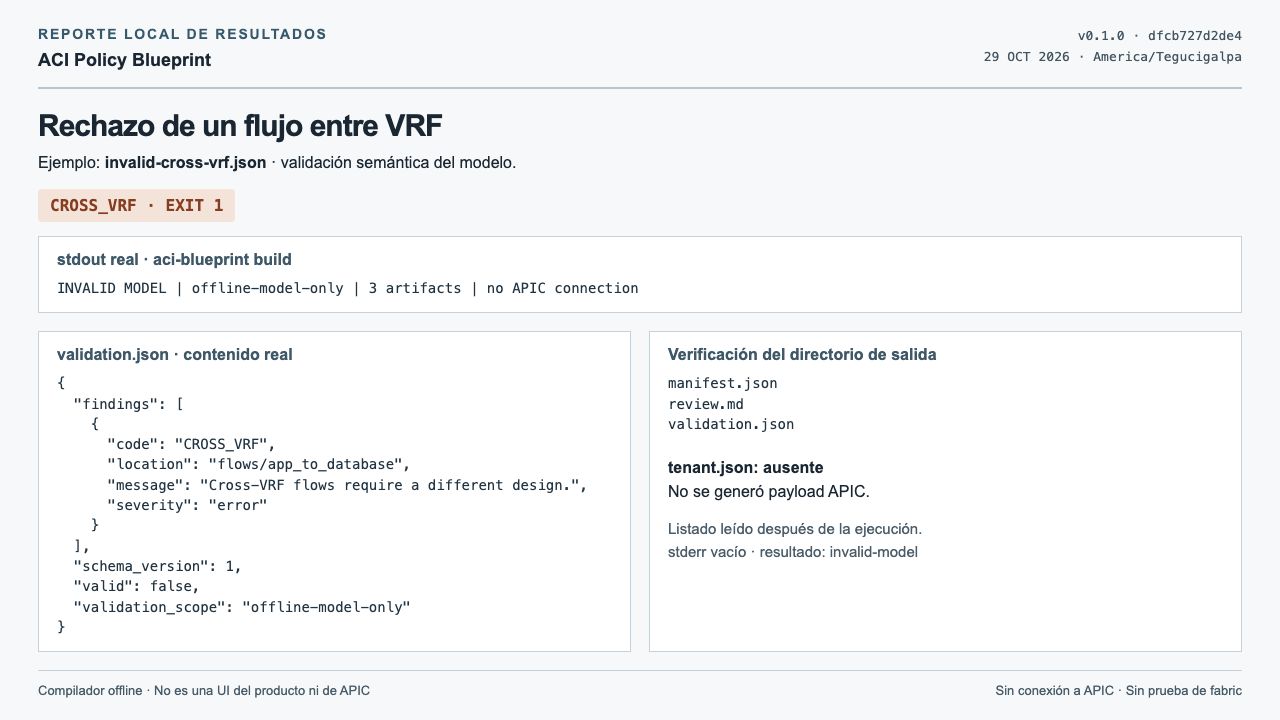 Enlarge
Cross-VRF flow rejected
The synthetic model returns exit 1 before an APIC payload is generated. No APIC connection or fabric test.
Source · 2026-10-29